WFP showcases refugee children’s art to support humanitarian work in Iran
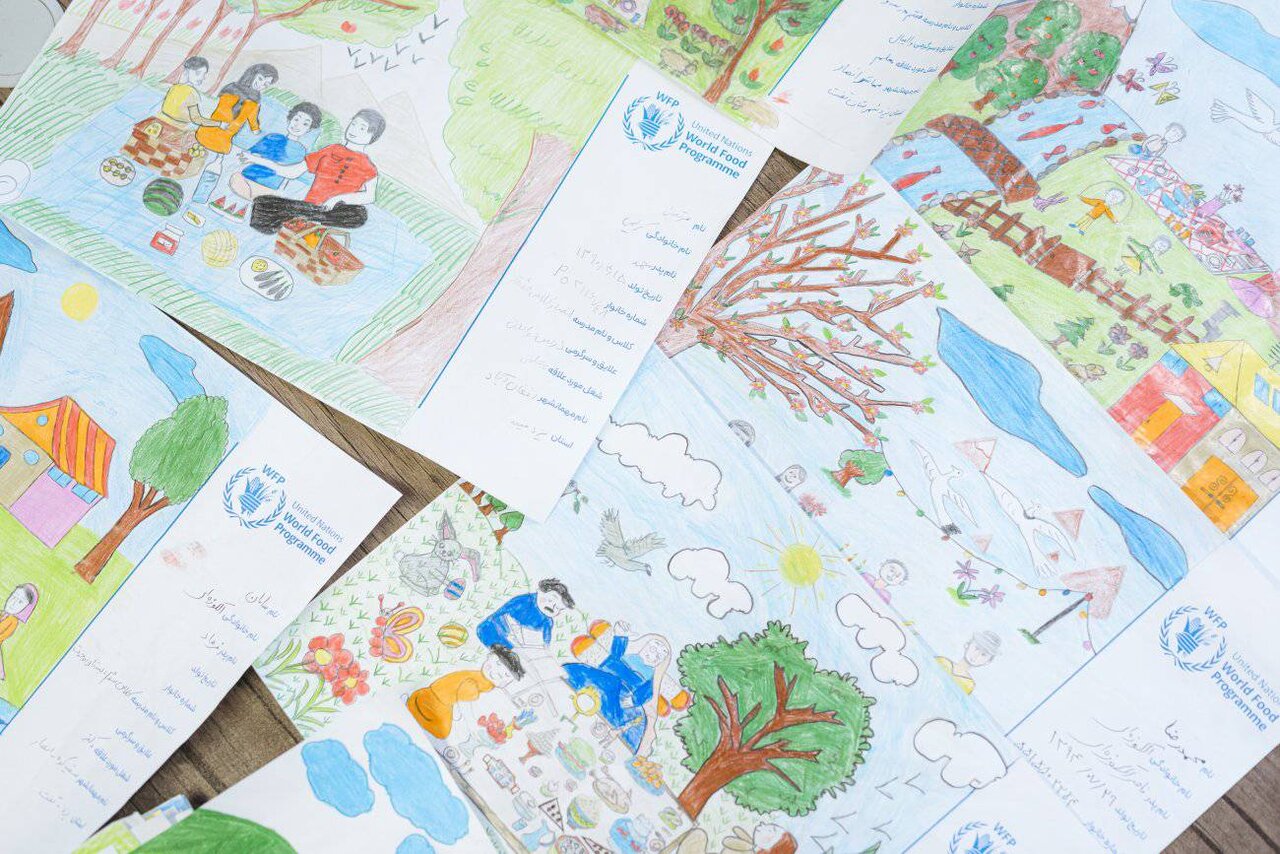
TEHRAN – The United Nations World Food Programme (WFP) has held an art exhibition featuring paintings by refugee children living in 20 settlements across Iran to raise support for its humanitarian operations in the country. The exhibition concluded on Friday.
The initiative brought the creativity, resilience and hopes of refugee children to the public through an art exhibition hosted at two well-known venues in Tehran, offering visitors a glimpse into their dreams, perspectives and experiences. Each artwork told a unique story, highlighting the creativity and determination of children who continue to pursue their aspirations despite the challenges they face, the UN website announced in a press release on October 21.
The artworks were displayed at Haman Store, a prominent concept store located in central Tehran, and Prague Pastry Boutique, an established Tehran brand with four branches across the city and a newly introduced concept store. Both venues were recognized for their distinctive approach to art, design, and community engagement, providing opportunities to introduce the children’s artwork to a wider audience.
Beyond celebrating artistic expression, the initiative also aimed to mobilize support for WFP’s humanitarian operations in Iran. Visitors had the opportunity to purchase the paintings, with proceeds contributing to WFP programs supporting vulnerable communities, including refugee children and conflict-impacted members of the host community.
These programs include school-based assistance, cash transfers and food support, helping families meet their essential needs while promoting children’s well-being and access to education.
WFP currently provides humanitarian assistance to approximately 60,000 people across Iran, including refugees and vulnerable members of host communities affected by the recent escalation.
Through this initiative, WFP seeks to connect the public with the stories of refugee children, celebrate their artistic talents and demonstrate how creativity and community engagement can contribute to humanitarian action.
WFP services
As part of the response to the recent escalation, WFP started to provide cash transfers to affected Iranian households, with the first round completed, reaching 340 households, of which 327 were male-headed households.
Assistance was provided according to household size: IRR 210 million (USD 139.1) for households of one to three members; IRR 350 million (USD 231.9) for households of four to five members; IRR 420 million (USD 278.3) for households of six or more members.
In 2025, WFP sustained food assistance to some 33,300 vulnerable refugees living in 20 settlements across 13 provinces, including 404 refugees with disabilities (40 percent women) who received monthly cash top-ups. About 183 women and 190 men received WFP livelihood support.
WFP doubled cash transfer values since January 2025, safeguarding access to food amid price volatility and protecting the most vulnerable households.
Assistance remained uninterrupted, with targeted adjustments: wheat flour entitlements reduced from 12 kg to 9 kg (Nov-Dec) and school snacks paused (Oct-Dec) to stretch limited resources.
To promote girls’ education and reduce barriers to attendance, approximately 2,629 girl students received cash incentives as part of WFP’s commitment to empowering young women. Some 9,261 boys and girls and their teachers benefitted from WFP school snacks.
For more than four decades, the Islamic Republic of Iran has hosted Afghans fleeing conflict and hardship. In 2025, WFP remained essential to protecting the food security of vulnerable refugees residing in 20 settlements, where households rely on shelter, education and primary health care by the Government and other humanitarian actors, complemented by WFP’s monthly food assistance (through cash and in-kind modalities).
The program’s focus is on maintaining a dignified minimum basic needs while prioritizing those with the highest vulnerability, including households headed by women and persons with disabilities.
Operations are implemented in close collaboration and coordination with the Center for Alien and Foreign Immigrant Affairs (CAFIA), WFP’s primary governmental counterpart, and with International Non-Governmental Organizations (INGO) and UN agencies, mainly the United Nations High Commissioner for Refugees (UNHCR), to ensure coherent refugee support and referral pathways.
Despite a complex year, marked by economic volatility and temporary operational risks, WFP sustained core assistance to settlement refugees. To safeguard purchasing power, WFP increased cash-based transfer values by 100 percent in January 2025 following the recommendation of a settlement-specific Minimum Expenditure Basket (MEB) assessment; this was complemented by a one-time cash top-up to cushion households during market instability and reduced income after the Iran-Israel 12-day conflict.
Targeted adjustments preserved program continuity: wheat flour entitlements were reduced from 12 kg to 9 kg per person for November-December, and the school snacks program was suspended for October to December.
These measures limit service disruptions while protecting life-saving transfers for the most vulnerable. Livelihood activities were scaled down given funding shortfalls and corporate efficiency measures, with WFP continuing to explore cost-effective, resilience-building options that can be re-activated as resources allow.
By December 2025, Iran continued to be one of the world’s largest refugee-hosting countries, sheltering approximately 2.5 million Afghans, including 773,000 individuals with official refugee status. Among them, around 35,000 critically vulnerable refugees reside in 20 settlements across 13 provinces.
MT/MG
Leave a Comment